Appwrite now supports deployment retention for Functions and Sites, letting you automatically delete old non-active deployments after a retention window you control. Deployment artifacts count toward your project's storage allowance on Appwrite Cloud, so retention reclaims that space and reduces storage overage on builds you would never roll back to.
The active deployment is always kept. Set deploymentRetention to 0 to keep non-active deployments forever, or choose a day-based value up to 36500 days. You can configure it from the Console or through the Functions and Sites APIs.
Database relationships in Appwrite are graduating from experimental to production-ready. After a year of performance, ergonomics, and capability improvements, they are now a first-class way to model connected data.
What's shipped over the past year
Opt-in relationship loading: Related rows are no longer pulled in automatically, you select exactly which relationships to load using query selection. Smaller payloads, faster responses.
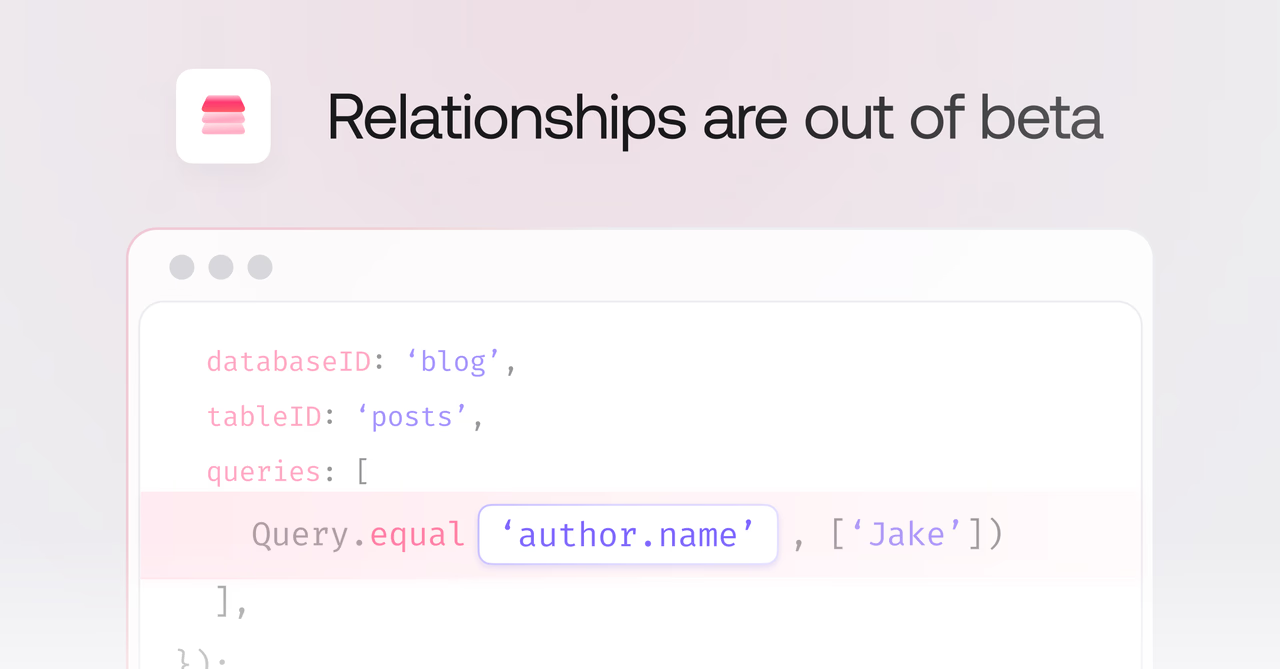
Filter queries on relationships: Filter across related data using dot notation, like Query.equal('author.name', ['Jake']). All comparison operators are supported, including equal, notEqual, greaterThan, lessThan, between, contains, and spatial queries.
12-18x faster relationship operations: A full internal overhaul made every relationship read, write, and join dramatically faster, with no configuration changes required.
CSV export support: Relationship fields export cleanly as IDs from the Console.
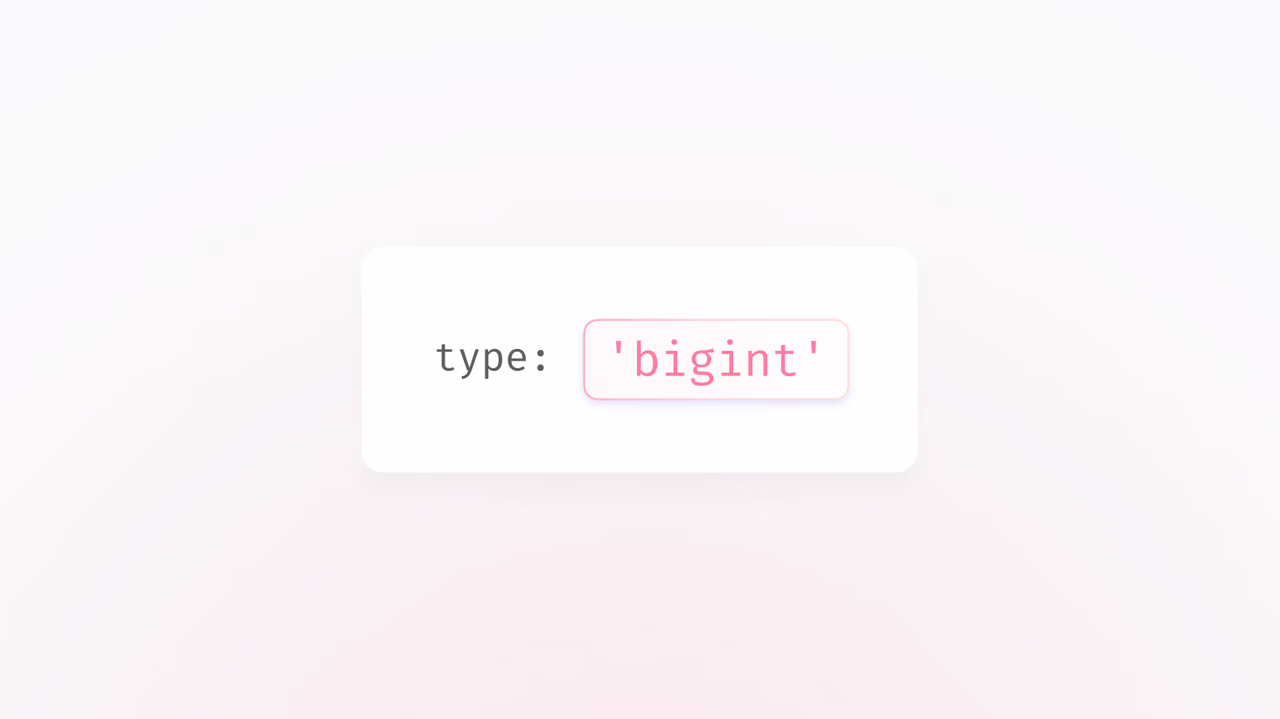
Appwrite Databases now supports BigInt columns, giving you a 64-bit signed integer type alongside the existing 32-bit integer. Use BigInt when your values may exceed the ±2.1 billion range of a regular integer, for example large counters, high-resolution timestamps, or external IDs from systems that use 64-bit keys.
BigInt columns accept optional min, max, and default parameters and work with Operators for atomic server-side updates, just like regular integers.
The Appwrite plugin is now available for Codex. Install it to get agent skills for the Appwrite CLI and every major SDK, two guided deployment skills for Sites and Functions, and the Appwrite Docs MCP server, all in a single setup.
Appwrite CLI 20.0.0 adds support for splitting large appwrite.config.json files into multiple local JSON files with a new includes field.
You can move supported resource arrays, such as functions, sites, tablesDB, tables, topics, teams, buckets, webhooks, and messages, into their own files while keeping init, pull, push, and run workflows unchanged. The CLI reads included resources into the same in-memory config shape and writes updates back to the file where each resource is defined.
Function and site paths are resolved relative to the file that defines them, so nested workspaces, packages, and submodules can keep resource configuration and source paths together.
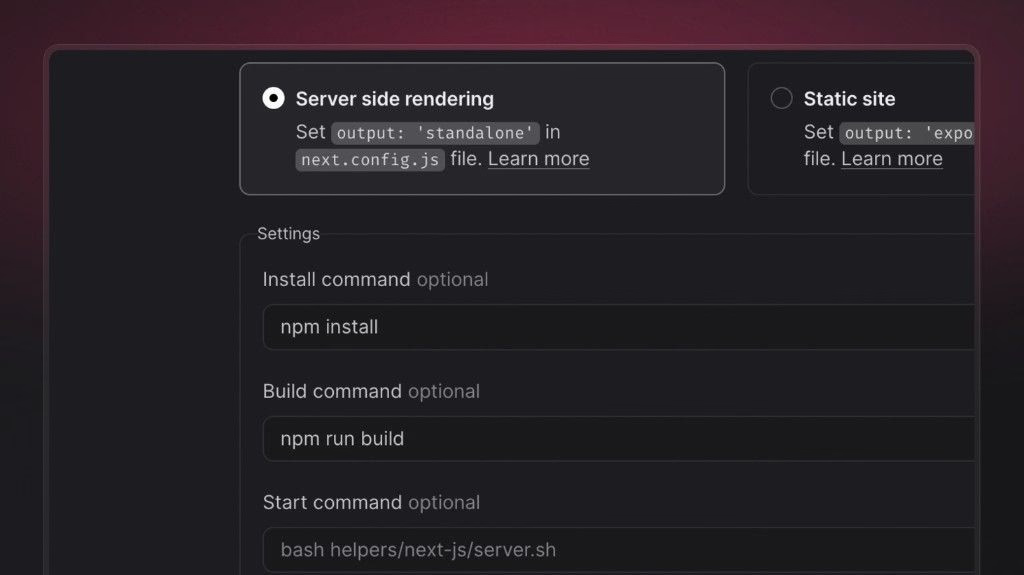
You can now set an explicit start command for server-side rendered (SSR) Sites in the Appwrite Console, alongside your existing build settings (install command, build command, and output directory). After a successful build, Appwrite uses this command to start the Node.js process that serves your app at runtime.
Framework presets still supply sensible defaults for common stacks. When you need more control, a dedicated start command helps you:
Point Appwrite at the exact script or binary that boots your server (for example a custom server.js, a framework CLI wrapper, or a workspace-specific package.json script).
Run monorepos and multi-package layouts where the server lives under a subpath or a different package than the build root.
Match team conventions (pnpm, yarn, npx) or CI-style commands without relying on whatever the preset inferred from the framework alone.
Try diagnostics or staging behavior at boot (for example extra logging or guarded startup) while keeping your build commands unchanged.
Configure it under your site’s Settings → Build settings when Server side rendering is enabled, then redeploy so the new command takes effect.
Appwrite Functions now supports Rust 1.83 as a first-class runtime. You can write functions in Rust, deploy them through the Appwrite CLI or Console, and pair them with the official Appwrite Rust SDK for type-safe, async access to every server API.
The runtime gives you compiled, memory-safe performance for the hot paths in your backend, payment and webhook signature verification, image processing, data transformation, and any workload where latency and predictability matter. It is available on Appwrite Cloud today.
A new Starter template for Rust is available in the function templates catalog, and the Functions documentation covers the runtime contract, request and response helpers, environment variables, dynamic API keys, and end-to-end examples for the new runtime.
Environment variables for functions, sites, and projects can now be created, listed, retrieved, updated, and deleted programmatically through the Appwrite Server SDKs. Two new API key scopes, project.read and project.write, control access to the project-scoped endpoints, alongside the existing functions.* and sites.* scopes for resource-scoped variables.
This enables configuration as code, one-place rotation of secrets shared across multiple resources, and repeatable bootstraps of new environments and tenants from scripts or templates.
Appwrite Realtime now keeps a single WebSocket per client session and applies incremental, message-based subscription changes instead of encoding subscription state mainly in the connection URL and reconnecting for every add or remove.
Previously, subscription details were often encoded in the WebSocket URL query string. That tied you to URL length limits in browsers, proxies, and servers, which capped how many channels you could combine and how much metadata you could send on one connection. It also squeezed Realtime queries for server-side filtering, because every extra filter still had to fit in the same limited URL. Channels and queries are now carried over the open socket, so you are not constrained by query-string size the same way.
In client SDKs, you can now:
Per-subscription lifecycle: Call unsubscribe() on a subscription handle to stop that listener only; other subscriptions on the same Realtime instance keep running.
update(): Change channels and queries on an existing subscription in place, without recreating the client.
disconnect(): Close the WebSocket and drop every active subscription in one call when your app is done with Realtime (for example on component unmount).
Together, the Realtime protocol change and matching SDK APIs reduce unnecessary reconnects, make UI-driven subscription changes easier to reason about, and move subscription state off the WebSocket URL onto incremental messages over the open connection.
Read the announcement on the blog for context and examples, and see the Realtime documentation for how this maps to your platform.
The Appwrite CLI 19.1.0 adds dedicated flags for filtering, sorting, and pagination on list-* commands, so you no longer need to hand-write Appwrite query JSON for --queries on common one-offs.
The new flags include --where, --sort-asc, --sort-desc, --limit, --offset, --cursor-after, --cursor-before, and --select. The --queries flag is still supported and is combined with the new flags when both are used. See the 19.1.0 release notes for more details.
We have raised the maximum build duration for Sites and Functions on Appwrite Cloud from 15 minutes to 45 minutes for organizations on the Pro plan and above. Free plan organizations keep the 15-minute build limit, so the longer window is an explicit benefit of upgrading when your workloads need it.
Build pipelines are rarely constant-time: cold dependency caches, larger lockfiles, native compilation, first-time container layer pulls, and multi-stage bundling can push wall-clock time well beyond a minimal compile on a warm workstation. A 15-minute cap often fails builds that are otherwise healthy, especially after cache invalidation, dependency upgrades, or when parity with a longer-running CI job matters. For Pro and above, extending the ceiling to 45 minutes reduces those false negatives, improves predictability when you are tuning compute for build versus runtime, and removes pressure to split deployments or strip build steps solely to stay under a short timeout.
On eligible plans, you get fewer interrupted builds on legitimate workloads, less time spent re-running jobs after transient slowdowns, and closer alignment between what you can run locally or in your own CI and what Appwrite Cloud will accept during the build phase. Teams shipping larger frontends, monorepo-style repositories, or functions with heavier packaging steps should see the clearest gain. Compare plans and limits on the pricing page.
You can now learn how to manage Appwrite project configuration as code with the official Terraform provider directly in our documentation. Define TablesDB resources, storage buckets and files, Auth users and teams, Functions and Sites, messaging providers, topics, subscribers, webhooks, backup policies, and more in .tf files, keep changes in version control, and apply the same setup across staging and production with less manual work in the Console.
The new Terraform provider section links to the Terraform Registry for full generated schemas and walks through configuration for Appwrite Cloud and Community Edition. We also added a Terraform provider entry in the integrations catalog.
Webhooks can now be created, updated, and deleted programmatically using the Appwrite Server SDKs. Two new API key scopes, webhooks.read and webhooks.write, control access to the new endpoints.
This makes it possible to provision webhooks as part of CI/CD pipelines, migration scripts, or any workflow where managing webhooks through the Console is not practical.
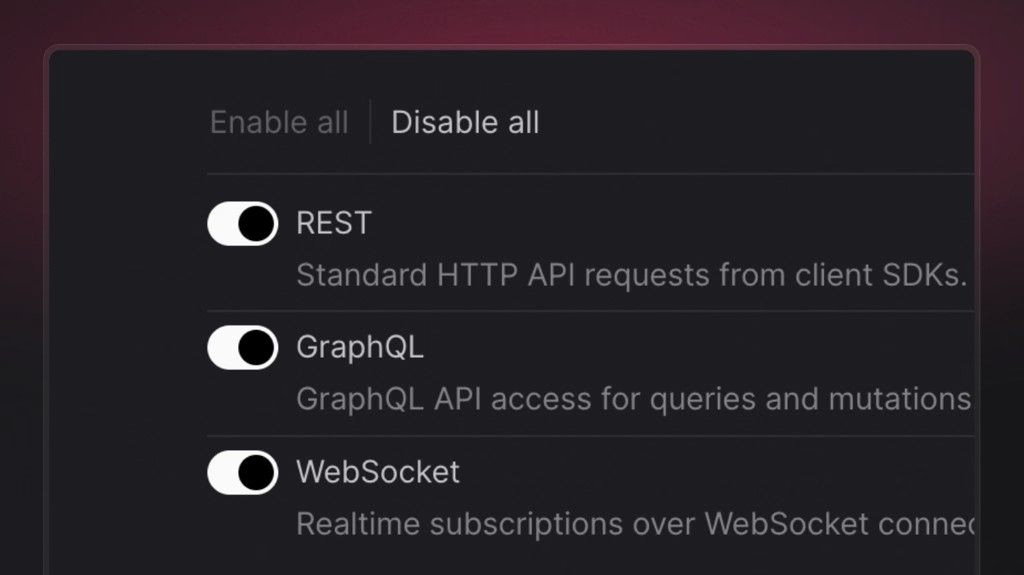
You can now choose exactly which API protocols your project exposes from the Appwrite Console. A new project setting lets you explicitly enable or disable each protocol so your application only talks to Appwrite the way you intend.
The following protocols can be toggled independently:
REST – standard HTTP API requests from client SDKs.
GraphQL – GraphQL API access for queries and mutations.
WebSocket – realtime subscriptions over WebSocket connections.
Turning off protocols you don’t use helps you:
Reduce exposure by removing entry points your app doesn’t need.
Minimize the abuse surface available to malicious traffic.
Enforce stricter access patterns that match your architecture.
You’ll find this under Project settings in your Appwrite Console.
The Appwrite plugin is now available for Claude Code. Install it to get agent skills for the Appwrite CLI and every major SDK, along with MCP servers for the Appwrite API and documentation, all in a single setup.