Why NoSQL databases are a better fit for AI applications than relational databases_
Discover why NoSQL databases outperform relational databases for AI applications, covering flexibility, scalability, use cases, and how to choose the right NoSQL database for AI workloads.

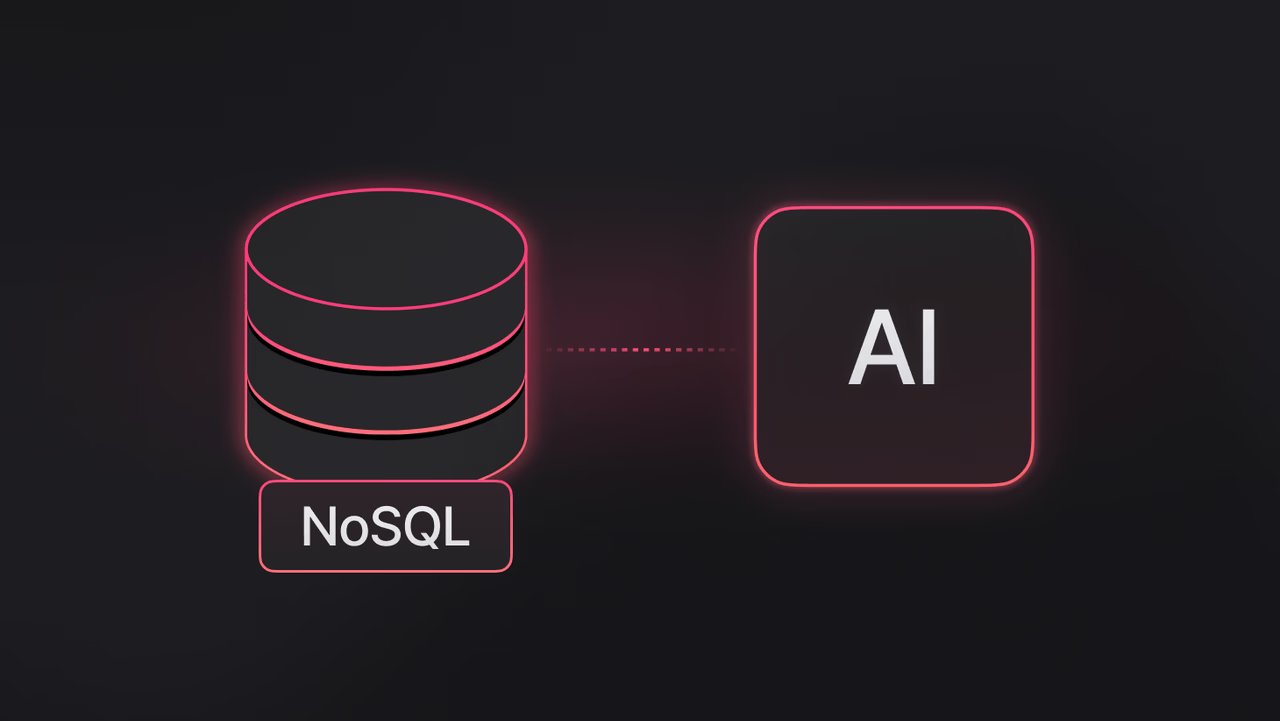
AI applications don't work with data the way traditional software does. They ingest logs, embeddings, user behavior, generated content, and constantly evolving model features (data that is dynamic, semi-structured, and inherently unpredictable). Traditional relational databases were never built for this. That's why NoSQL databases have become the default starting point for a lot of modern AI workloads.
But choosing the right NoSQL database for AI isn't a simple decision. It requires understanding what makes NoSQL different, which type fits your use case, and where relational databases still belong.
What are NoSQL databases?
NoSQL databases, short for Not Only SQL, are non-relational database systems designed to store, retrieve, and manage unstructured, semi-structured, and rapidly changing data. Unlike traditional relational databases that rely on fixed schemas and structured tables, NoSQL databases offer flexible data models that can evolve alongside your application without costly migrations or downtime.
This flexibility is what makes NoSQL databases especially well-suited for AI. In most AI applications, data formats shift constantly, new model features get introduced, old ones are dropped, and different records often need entirely different structures. A rigid schema gets in the way of that. NoSQL doesn't.
Why AI data doesn't fit relational databases
Relational databases were built for predictable, structured data: rows, columns, fixed schemas, and clearly defined relationships. That model works well when your data is consistent, and your structure is stable (think billing records, inventory, or user accounts).
Data in AI apps looks nothing like that. A typical AI application might store user interaction events, text embeddings and high-dimensional vectors, logs and telemetry, model inputs and outputs, and metadata for images, audio, and video, often all at once. None of this follows a single schema; all of it changes frequently, and it grows fast. Forcing it into relational tables leads to constant migrations, fragile joins, and slower development cycles. NoSQL databases, with their document, graph, key-value, and column-family models, are designed for exactly this kind of complexity.
Types of NoSQL databases for AI
Not all NoSQL databases are alike, and choosing the right type matters as much as choosing NoSQL over SQL in the first place. Each type solves a different problem, and most production AI systems end up using more than one.
Document databases like MongoDB and Couchbase store flexible, JSON-like data, making them great for user profiles, AI-generated content, and fast-changing model features. Chatbots, sentiment analysis tools, and translation services all rely on vast amounts of unstructured text that document stores handle far more naturally than relational alternatives.
Key-value stores like Redis and DynamoDB offer ultra-fast lookups, ideal for caching and serving AI outputs at low latency. Any real-time inference pipeline that needs to retrieve precomputed results quickly benefits from this model.
Column-family stores like Cassandra and HBase are built for massive write throughput, making them well-suited for high-volume AI data pipelines ingesting logs, telemetry, or behavioral data at scale.
Graph databases like Neo4j and Neptune model relationships natively, the right choice for AI-powered recommendations, fraud detection, and knowledge graphs, where the connections between users, products, and behaviors matter as much as the data points themselves.
Vector databases like Pinecone, Weaviate, and Qdrant are purpose-built for storing and querying high-dimensional vector embeddings. This makes them essential for modern AI workloads: semantic search, retrieval-augmented generation (RAG), image similarity, and any application where meaning needs to be encoded and retrieved at scale. As embedding-based AI becomes the norm, vector databases are quickly becoming a foundational part of the AI infrastructure stack.
The real advantages of NoSQL for AI workloads
The case for using NoSQL databases for AI comes down to three things: flexibility, scalability, and data compatibility.
- Schema flexibility: AI systems evolve constantly. In a relational database, even small schema changes can require migrations and planned downtime. NoSQL databases sidestep this entirely, you can add new fields on the fly, nest complex structures, and let different documents have different shapes without touching a schema definition. For ML teams that ship and iterate daily, that directly accelerates development.
- Horizontal scalability: AI applications demand a lot from infrastructure, millions of events per day, real-time inference, and continuous data ingestion. Relational databases can scale, but typically through vertical scaling or complex sharding, both of which add significant overhead. NoSQL databases are architected for horizontal scaling from the start, distributing data across nodes naturally and sustaining high throughput without major re-engineering as workloads grow.
- Native support for unstructured data: Vector embeddings, image metadata, and raw text simply don't fit neatly into rows and columns. NoSQL databases handle these formats natively, making them the practical choice for any application that goes beyond simple structured queries.
A closer look: MongoDB for AI applications
Among document databases, MongoDB stands out as one of the most widely adopted for AI workloads. Its flexible document model makes it easy to store and query diverse data types, from raw text and metadata to nested model outputs, without upfront schema commitments. MongoDB's aggregation pipeline, Atlas Search, and native support for JSON make it a natural fit for teams building on top of LLMs or managing large volumes of AI-generated content.
For teams using MongoDB Atlas (MongoDB's managed cloud offering), Atlas Vector Search brings vector similarity search directly into the same database where your application data already lives, valuable for RAG-based applications where you want to avoid maintaining a separate vector store. For self-hosted MongoDB deployments, a dedicated vector database such as Qdrant or Weaviate is the recommended path for embedding search.
NoSQL vs SQL: Knowing when to use each
NoSQL databases are the better default for dynamic, high-volume, unstructured workloads, but SQL isn't going away, nor should it. Relational databases remain the right choice for financial transactions, reporting, and analytics, and any system where strong consistency and ACID guarantees are non-negotiable. They've been refined over decades for exactly those scenarios, and they do them well.
The more useful question isn't "NoSQL or SQL?"
It's "which one for which part of my system?"
Most mature AI systems use both: a relational database handling the structured, transactional layer, and a NoSQL database managing the dynamic, AI-driven workloads on top. The teams that struggle are usually the ones trying to force a single database to do everything, rather than letting each tool handle what it was built for.
Building AI backends with NoSQL
Picking the right NoSQL database for AI is only one part of building a production-ready AI backend. Teams also need secure APIs, authentication, file storage, and real-time capabilities, and assembling all of that from scratch adds significant overhead before you've written a single line of model code. It's easy to underestimate how much time goes into infrastructure that has nothing to do with the actual AI work.
Appwrite is an open-source backend platform built to work naturally alongside NoSQL databases. It ships with built-in auth, APIs, storage, and real-time updates out of the box, so teams can focus on building and improving their AI models rather than stitching together infrastructure. For teams that want to move fast, self-host Appwrite with MongoDB configured and get started immediately.
The bottom line
AI data is messy, fast-moving, and hard to predict in advance. NoSQL databases align naturally with that reality, offering schema flexibility, faster iteration, and horizontal scalability that relational databases simply weren't built to provide. SQL remains essential for transactional and reporting systems, and the best AI backends use both deliberately, with each doing what it does best. But if you're building something AI-driven and starting from scratch, NoSQL databases are the stronger foundation to build on.