Best vibe coding tools in 2026: comparison and tradeoffs_
Compare the best vibe coding tools for developers, including Cursor, Windsurf, Claude Code, GitHub Copilot, Google Antigravity, OpenAI Codex, OpenCode, Bolt, Lovable, and more. See strengths, tradeoffs, pricing, and ideal use cases.


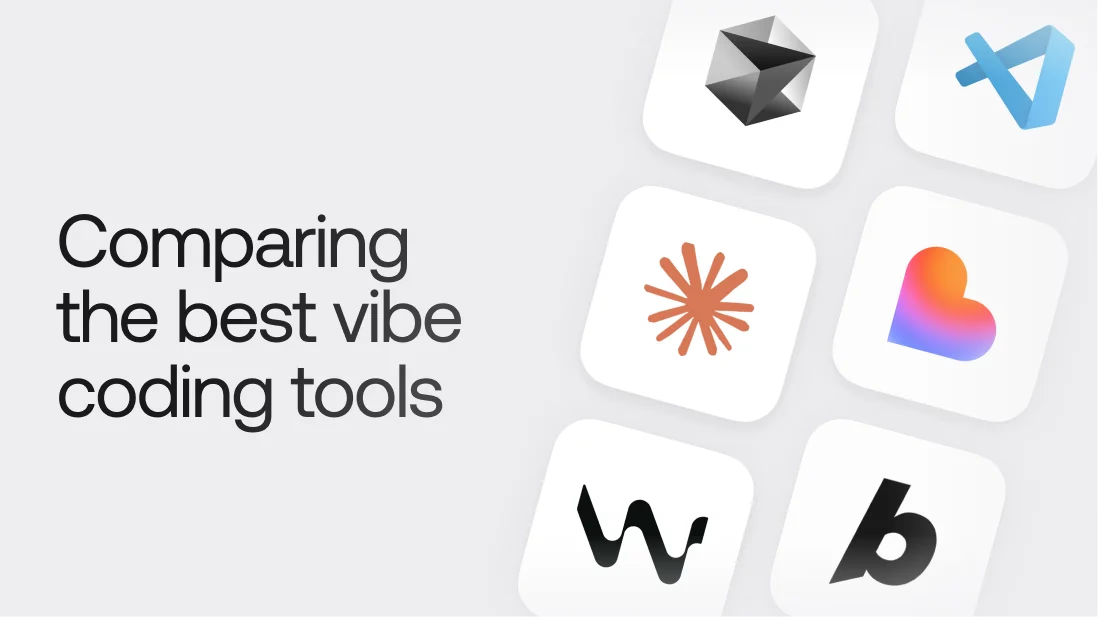
If you are searching for the best vibe coding tools, this guide compares Cursor, Windsurf, Claude Code, GitHub Copilot (in VS Code), Google Antigravity, OpenAI Codex, OpenCode, Bolt, Lovable, and where Replit fits, based on sustained use on real full-stack projects, not launch-day demos. Updated for 2026: pricing and positioning move fast; use the Updated line just below the cover image for the refresh date. The tradeoffs below are what still matter week three of a codebase.
The goal is not a feature checklist. It is how each tool behaves when you add features, chase bugs, and revisit logic later. By the end, you should have a clear pick by use case (daily IDE, terminal agent, prototype in the browser, or team default on GitHub), plus direct answers for common “versus” searches.
Quick verdict: best vibe coding tools
Short picks if you only read one section:
- Cursor - Best overall AI coding IDE for serious refactors, file context, and
.cursorrules-style control (watch for performance on huge repos). - Windsurf - Best for agentic IDE workflows when you want direct edits and a polished UI; mind monthly credit caps on paid tiers.
- Claude Code - Best terminal-native coding agent when you want Anthropic’s models driving repo work without living inside a forked editor.
- GitHub Copilot - Best for teams already on VS Code and GitHub who want a mature agent without switching editors.
- Bolt - Best for fast browser-based full-stack prototypes; expect to export when complexity grows.
- Lovable - Best for non-technical builders and quick UI generation; similar ceiling to Bolt when requirements leave the template path.
- Replit - Best all-in-one cloud development environment when hosting, editor, and AI should live in one tab (not deep-dived here, but it belongs on the same short list).
- Google Antigravity - Best when you want a Gemini-first agent IDE and tight fit with Google’s toolchain; mind quotas and policy the same way you would for any cloud-backed assistant.
- OpenAI Codex - Best when you already standardize on ChatGPT / OpenAI and want a first-party agent plus CLI without adopting a forked editor.
- OpenCode - Best when you want a terminal-native, open-source agent stack you can audit, extend, and often self-host next to Claude Code-style workflows.
VS Code with GitHub Copilot
A year ago, Copilot felt like it was falling behind other tools. Today, it has caught up and, more importantly, has become easier to trust. What used to function as a smart autocomplete layer has become something more substantial, with an agent mode that handles file generation, multi-step instructions, and project-aware changes.
Its main strength is its smooth integration with VS Code. There is no friction, no need to adopt a new editor or adjust your workflow. It gets out of the way, supporting what you're already doing rather than trying to become your IDE. The line between Copilot and other tools like Cursor has gotten blurrier, and for many developers, Copilot now does most of the things they used to need a more specialized tool for.
The pricing is also reasonable, and hasn't been a pain to manage. You install it, connect your GitHub account, and it just works. If Copilot had stayed where it was a year ago, I wouldn't be using it for any serious work. But today, it's the one I now use as my daily driver.
That said, its inline completion is far behind Cursor and Windsurf. It struggles to understand file context or make meaningful suggestions (when compared to Cursor). This is not a deal breaker, but it's something to consider.
Cursor for vibe coding
Cursor remains one of the most technically capable AI development environments, built for deep structural work. Its strength is control. It allows for structured instructions, file referencing, and project-specific rules (.cursorrules), enabling it to perform complex rewrites when guided well. The recent pricing update, with its unlimited auto mode, makes it easier to use for daily workflows.
Cursor now prices its usage based on tokens instead of number of requests. They add markups to the rates of high-end models like Anthropic's Claude or OpenAI's GPT-5. Its auto mode, however, routes to different models depending on complexity of the prompt, is billed at a fixed token rate, and works surprisingly well.
However, I've noticed that on large codebases, Cursor can lag, freeze while indexing, or stall on file edits, even on high-performance computers (I use a MacBook M3 Pro). This is probably the same experience other similar AI editors might have, since they're mostly all VS Code forks.
I still recommend it for serious work, although I've been using it less and less.
Windsurf for vibe coding
Windsurf offers a clean interface and behaves predictably, making it a decent assistant for front-end or mid-sized projects. Edits are applied directly, giving a sense of immediate feedback with little configuration needed.
The tool is held back by two key issues. The first is its pricing model, which caps requests at 500 per month on its base paid tier, a limit that professional developers can hit quickly. The second is a lack of trust in its long-term direction, especially after its founders departed for Google. Every other thing about how Windsurf works is similar to Cursor, although I prefer some of the UI elements in Windsurf, and they seem to go an extra mile in making their user experience friendlier.
Bolt for vibe coding
Bolt takes a different approach, running entirely in the browser and using integrated features to generate full-stack applications.
For scaffolding projects with a frontend, backend, and database, Bolt performs well. It generates sensible file structures and code that is more consistent than similar tools. One thing to note is that Bolt rewrites entire files when making edits, rather than targeting specific code sections like traditional code editors. Since Bolt prices based on token usage, rewriting entire files for minor changes quickly depletes user tokens, which can make it expensive for iterative development.
Bolt shows good promise for prototyping and its outputs are usually clean. Although it doesn't yet come across as a full development environment. As logic complexity increases, the output requires extensive restructuring, and developers will likely need to export the code to finish it elsewhere. Generally, I find Bolt great for quick prototypes but less suitable for ongoing development work.
Lovable for vibe coding
Lovable is designed for speed, and tries to position itself as the fastest way to get from a prompt to a working web application. For landing pages, internal tools, or demos, it delivers a smooth experience, and can spin up a live frontend with a clean aesthetic that can be tweaked through a visual editor.
Lovable is similar to Bolt in more ways than it is to other tools like Cursor and Windsurf. This means that just like with Bolt, as soon as requirements shift from the standard quick prototypes and templates, the assistant can become less helpful. Generally, I've found lovable to be more polished at the UI/UX level but less structured under the hood.
That said, a lot of non-developers are already using it daily to build out their ideas without much hassle, and this is a good strength for Lovable.
Claude Code for vibe coding
Claude Code operates in your terminal, which feels like a step backward until you realize it's actually solving a different problem. Instead of another VS Code fork, Anthropic built something that works where many developers already spend their time.
There's no UI to learn, but that also means no visual feedback during longer operations. You're trusting that it understands your codebase correctly, which it often does, but when it doesn't, debugging becomes more difficult than with GUI-based tools.
The pricing structure is where things get complicated. Claude Code starts at $20/month for the Pro plan, which gives you roughly 10-40 prompts every five hours. This limits its usefulness for larger projects.
The Max plans at $100-200/month provide more capacity, but the usage limitations scale with complexity. The terminal-only approach doesn't appeal to me, but many developers report that Claude performs better via Claude Code than when accessed through other tools. So I'd say it's worth a try despite the pricing.
Google Antigravity for vibe coding
Antigravity is Google’s agent-first IDE: an agent plans, edits, and runs across a workspace with Gemini at the center. It is the natural fit when your org already standardizes on Google accounts, GCP-style workflows, and Gemini access, and you want that stack inside the editor instead of bolting agents onto a generic fork.
The tradeoffs mirror other cloud-backed assistants: quotas, safety filters, and product boundaries deserve the same procurement and review discipline you apply to Copilot or Cursor. Pick it when vendor alignment and IDE-native Gemini are what your team already optimizes for.
OpenAI Codex for vibe coding
Codex (including the CLI / agent path OpenAI ships beside ChatGPT) does the same class of work as Claude Code for many teams: repo-aware changes from a terminal or thin UI, billed through what you already pay via ChatGPT Plus / Pro / Business or related OpenAI plans.
It is strongest when you want one vendor for chat, research, and coding agents, and when procurement is already comfortable with OpenAI’s terms. It is a weaker fit only if you refuse to leave a forked editor that already carries your whole workflow.
OpenCode for vibe coding
OpenCode (sometimes written Opencode) is a terminal-first, open-source agent stack for teams that want inspectable code, community patches, and self-hosting next to multiple model providers.
It sits alongside Claude Code as a serious terminal option, with different defaults on licensing, plugins, and built-in UI. Cost is usually API keys plus any infra you run; budget tokens and observability the same way you would for any production agent.
Cursor vs Windsurf
Who Cursor is for: developers who want maximum control over multi-file refactors, strong file context, and project-level rules, and who can tolerate occasional heaviness on large repositories.
Who Windsurf is for: developers who want a streamlined agentic IDE with direct edits and friendly UX, and whose usage fits within credit limits.
Tradeoffs: Cursor wins on depth and configurability; Windsurf often feels lighter to operate day to day. Windsurf’s pricing caps can interrupt flow; Cursor’s indexing and edits can stutter on very big trees.
Recommendation: choose Cursor when agent throughput and structural edits are the bottleneck; choose Windsurf when you prioritize polish and moderate, predictable usage.
Claude Code vs Windsurf
Who Claude Code is for: engineers who already drive work from the terminal and want a capable agent without adopting another GUI-first editor.
Who Windsurf is for: anyone who wants inline diffs, click-to-apply patches, and a traditional IDE loop.
Tradeoffs: Claude Code avoids editor lock-in but makes inspection and iteration more abstract. Windsurf gives immediate visual feedback but ties you to an IDE stack and vendor roadmap questions called out earlier.
Recommendation: pick Claude Code for terminal-native workflows; pick Windsurf when the IDE surface is non-negotiable.
Cursor vs Claude Code
Who Cursor is for: teams that want AI inside a visual editor with tabs, search, and side-by-side review.
Who Claude Code is for: teams comfortable reviewing changes with git, tests, and shell tooling instead of inline UI.
Tradeoffs: Cursor is faster to see mistakes; Claude Code is faster to dispatch work if you already script and navigate from the shell. Pricing models differ: Cursor’s token routing versus Claude Code’s time-boxed usage windows.
Recommendation: default to Cursor for collaborative app work; try Claude Code if your best work already happens in tmux and ssh sessions.
Cursor vs Windsurf vs Claude Code
Think in three lanes: IDE-first (Cursor vs Windsurf) and terminal-first (Claude Code). Between Cursor and Windsurf, the decision is mostly ergonomics, caps, and how hard you push agents across large folders. Pull Claude Code into the shortlist when you want the agent where your scripts already live, not inside another fork of VS Code.
Recommendation: Cursor for the highest ceiling in an AI IDE today, Windsurf as the cleaner IDE alternative if limits work for you, Claude Code when the terminal is home.
Comparison table
| Feature | VS Code + Copilot | Cursor | Windsurf | Bolt | Lovable | Claude Code | Google Antigravity | OpenAI Codex | OpenCode |
|---|---|---|---|---|---|---|---|---|---|
| Best use case | Daily development workflow | Complex structural work | Front-end & mid-sized projects | Quick prototyping | Landing pages & demos | Terminal-first Anthropic agent | Gemini-first agent IDE, Google stack | OpenAI-native agent and CLI | Open terminal agents, multi-model |
| Integration | Smooth VS Code integration | VS Code fork with enhanced AI | Clean interface, direct edits | Browser-based | Web-based with visual editor | Terminal with IDE extensions | Agent-first IDE on Gemini | ChatGPT ecosystem, CLI, thin UI | Terminal, OSS, bring-your-own keys |
| Pricing (monthly) | Free: 50 chats, 2K completions / Pro: $10/month / Pro+: $39/month | Free: Limited requests / Pro: $20/month / Ultra: $200/month | Free: 25 credits / Pro: $15/month / Teams: $30/user | Free: 1M tokens / Pro: $20/month / Teams: $30/user | Free: 5 daily credits / Pro: $25/month / Business: $50/month | Pro: $20/month / Max: $100/month / Max 20x: $200/month | Gemini-linked plans (confirm in your Google account) | ChatGPT plans and/or API-style metering | Often keys only; optional self-hosted infra |
| Free tier limits | 50 agent requests, 2K completions | Limited agent & tab completions | 25 prompt credits/month | 1M tokens/month, 150K daily | 5 daily credits (up to 30/month) | No free tier (starts at $20/month) | Varies by Google offering | Tied to ChatGPT tier or trial | Depends on keys and hosting |
| Inline completion | Decent | Excellent | Excellent | N/A | N/A | N/A | Strong in IDE | Limited in thin UI | N/A |
| File context understanding | Good | Excellent | Good | Good for prototypes | Good for prototypes | Good | Good | Good | Good |
| Complex rewrites | Good | Good | Good | Good for prototypes | Good for prototypes | Good | Good | Good | Good |
| Learning curve | Minimal (existing VS Code users) | Moderate | Moderate | Low | Low | Low (if comfortable with terminal) | Moderate | Low to moderate | Moderate (terminal ops) |
| Multi-file editing | Yes | Yes | Yes | Yes | Yes | Yes | Yes | Yes | Yes |
| Code quality | Good | Good | Good | Good for prototypes | Good for prototypes | Good | Good | Good | Good |
| Deployment options | Manual (via Git/CI) | Manual (via Git/CI) | Manual + 1-click previews | Direct deployment | Direct hosting | Manual (with git assistance) | Manual (via Git/CI) | Manual (via Git/CI) | Manual + optional self-host |
| Enterprise features | Teams plans available | Teams & Enterprise plans | Teams & Enterprise plans | Teams & Enterprise plans | Business & Enterprise plans | Enterprise exclusive | Google Workspace-style paths | OpenAI business plans | Self-managed / community |
The table is wide on small screens; horizontal scroll is normal for a full-field comparison.
Pricing summary
GitHub Copilot: Most affordable option with a generous free tier. Pro at $10/month offers unlimited completions and chats.
Cursor: Mid-range pricing with unlimited Tab completions on Pro ($20/month). Ultra tier ($200/month) provides 20x usage limits.
Windsurf: Credit-based system starting at $15/month for 500 credits. Teams plan at $30/user includes admin features.
Bolt: Token-based pricing similar to Windsurf. Free tier offers 1M tokens monthly, which can finish quickly because of the full file rewrites for every edit.
Lovable: Credit-based system focused on rapid development. Pro at $25/month includes 100 monthly credits plus rollovers.
Claude Code: Pricing from $20-200/month with usage limits that vary by codebase size. Pro plan works best for smaller repositories, with higher tiers needed for larger projects.
Google Antigravity: Gemini-linked billing or workspace entitlements; confirm the current bundle in your Google account the same way you validate Copilot or Cursor tiers before a team rollout.
OpenAI Codex: Often bundled with ChatGPT Plus / Pro / Business or metered API-style usage for the CLI; compare against what you already pay OpenAI before adding parallel IDE subscriptions.
OpenCode: Typically API keys plus any hosting you add; the software can be free while tokens and ops time are not.
Final thoughts
A year ago, the choice for serious AI-assisted development seemed clear. Today, the lines are blurring. GitHub Copilot which used to be an afterthought has matured into a good default that is easy to adopt.
Cursor excels at structured, large-scale changes. Windsurf offers a clean user flow with its business model raising questions about long-term viability. Claude Code brings a terminal-native Anthropic agent that appeals to shell-first developers. Google Antigravity matches teams that want a Gemini-first agent IDE inside Google’s stack. OpenAI Codex matches teams that want OpenAI’s agent and CLI on the same contract as ChatGPT. OpenCode matches teams that want open, terminal-native agents with multi-model freedom. Bolt and Lovable are good for rapid prototyping and scaffolding, though I've found them best suited for specific use cases rather than full development workflows.
All these tools can generate code, but the real difference is how they behave when it matters, when the codebase is large, the deadline is tight, and you need an assistant that helps more than it hinders. Developers who understand the edges of each platform will have a good advantage in this new era of AI-assisted development.
There is no single winner. Cursor is the strongest AI-first IDE for large refactors and project rules, GitHub Copilot is the easiest default inside VS Code, Claude Code fits terminal-native agent workflows, Windsurf is a capable alternative IDE with a simpler surface, Google Antigravity fits a Gemini-forward agent IDE inside the Google stack, OpenAI Codex fits ChatGPT subscribers who want a first-party agent and CLI, OpenCode fits an open, terminal-first agent you can inspect and self-host, and Bolt or Lovable fit a hosted prototype fast. Choose from how you work, not from a feature matrix alone.
Professional teams weigh Cursor for aggressive multi-file edits and .cursorrules, Windsurf for a polished agentic IDE with direct edits, Claude Code for a capable terminal-native agent, GitHub Copilot when stock VS Code and GitHub matter most, Google Antigravity for a Gemini-first agent IDE inside the Google stack, OpenAI Codex when OpenAI subscriptions and a first-party agent plus CLI are the standard, and OpenCode when terminal agents, inspectable source, and self-hosting sit alongside model choice. Bolt and Lovable stay in the mix for hosted prototypes.
Cursor generally leads on deep codebase refactors, file context, and configurability, at the cost of heavier indexing and occasional lag on very large repos. Windsurf feels cleaner for day-to-day edits and onboarding, but its paid tiers can cap usage quickly. Prefer Cursor when agent throughput and control matter most; prefer Windsurf when you want a lighter IDE feel and moderate usage fits your budget.
They solve different surfaces. Claude Code is a terminal-native agent: powerful when you already live in the shell and want repo-wide changes without a dedicated AI editor, but you lose inline visual diff ergonomics. Windsurf is a full IDE with immediate visual feedback. Pick Claude Code for terminal-first workflows; pick Windsurf when an integrated editor and UI matter.
Bolt, Lovable, and Replit are the fastest on-ramps for browser-first builders: less setup, more guided UI, and quick deploys. Move to Cursor, Windsurf, Google Antigravity, VS Code plus GitHub Copilot, Claude Code, OpenAI Codex, or OpenCode once you need real version control, refactors across many files, or production hardening, because that is where IDE-native and terminal-native tools earn their keep.