Why schema-less databases are better for modern AI workloads_
Discover why schema-less databases outperform relational databases for AI workloads, covering flexibility, scalability, key use cases, and how to build faster AI backends.

AI innovation moves fast. Traditional database schemas don't. That gap is one of the biggest reasons AI projects slow down after the prototype stage, and it's why schema-less databases have become the go-to choice for teams building modern AI systems.
Most teams focus on model performance. But the real friction tends to appear in the data layer. As AI workloads grow and evolve, rigid data structures become increasingly difficult to maintain, and the database starts slowing the team down instead of enabling them.
What are schema-less databases?
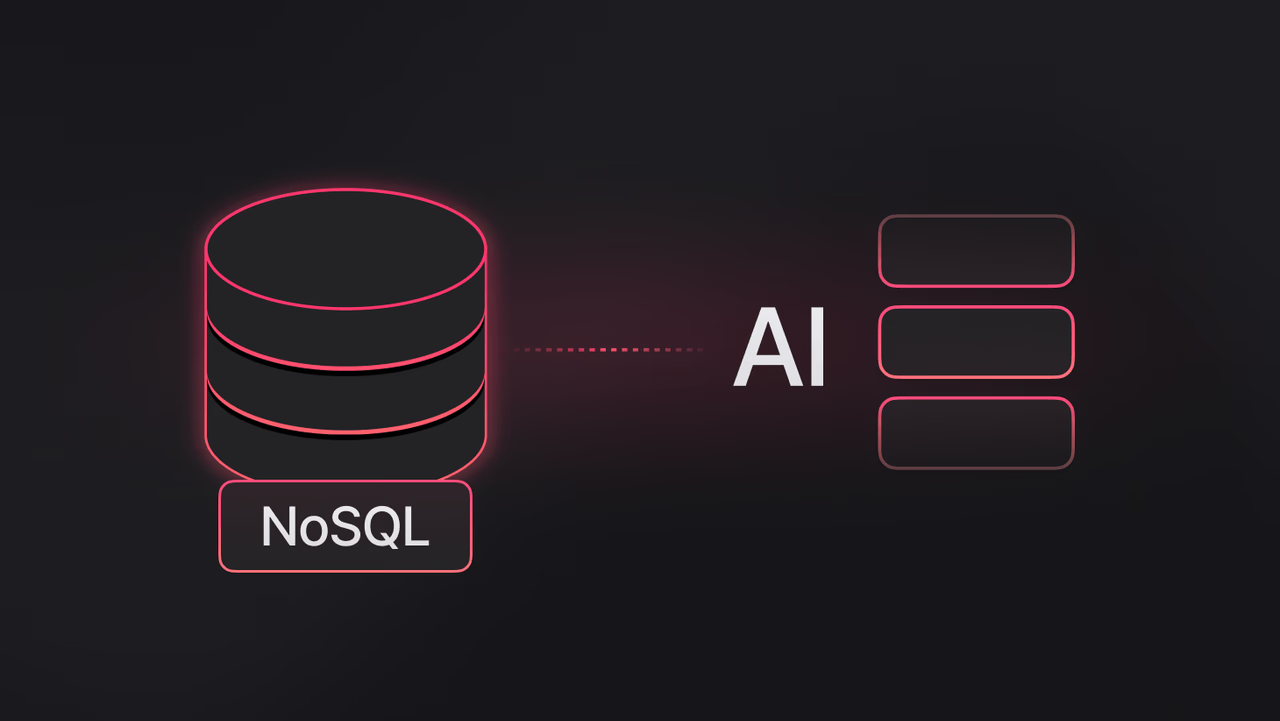
A schema-less database, often referred to as a NoSQL database, is designed to store and manage data without requiring a fixed, predefined structure. Unlike relational databases, where a schema defines every table, field type, and relationship upfront, schema-less databases allow each record to evolve independently. New fields can be added without breaking existing data, and different versions of the same record type can coexist without conflict.
This flexibility makes schema-less databases especially valuable for AI workloads, where data is highly variable, pipelines change frequently, and the shape of model inputs and outputs rarely stays the same for long.
Why rigid schemas don't work for AI
Relational databases were designed for structured, predictable data. They work extremely well for systems where consistency and strict relationships are critical, financial transactions, inventory management, order processing, and accounting platforms all fit this model well.
AI workloads deal with a fundamentally different kind of data. A typical AI system might store text and conversational data, image metadata and embeddings, event streams, model predictions, experiment results, and user feedback signals, often all within the same pipeline. None of this has a fixed shape, and all of it changes as models are retrained and features are updated.
When teams try to force this dynamic data into a rigid schema, the friction compounds quickly. Every structural change requires planned migrations, query updates, cross-service coordination, and historical data backfills. Engineering time gets spent on database maintenance instead of model improvement. Many AI projects don't fail because the models are weak, they fail because the infrastructure slows the team down.
Key advantages of schema-less databases for AI workloads
The case for schema-less databases in AI comes down to three core strengths:
- Flexible data models: Records aren't bound to a fixed structure, so new fields, data types, and nested structures can be added as the AI system evolves, without migrations, downtime, or breaking changes to existing data.
- Faster experimentation: Teams can store different model outputs, track experiment metadata, and test new features without redesigning the database each time. The data layer stops being a blocker and becomes an enabler.
- Horizontal scalability: Schema-less databases are built to scale out across nodes, handling high write volumes and continuous data ingestion, common demands in AI pipelines, far more naturally than vertically scaled relational systems.
Where schema-less databases make the biggest difference
Natural language processing and conversational AI
Chatbots, sentiment analysis tools, and translation services generate unstructured, highly variable text data. Schema-less databases handle this naturally, without requiring teams to define and maintain rigid structures around data that changes with every model update.
Computer vision and image recognition
These systems produce large volumes of image metadata, annotations, and high-dimensional vector embeddings. A flexible data model makes it straightforward to store and retrieve this data alongside the predictions and feedback signals that feed back into training.
Real-time AI pipelines
Systems that ingest logs, telemetry, or behavioral data at scale need high write throughput and the ability to handle evolving data formats. Schema-less databases are purpose-built for this, new fields can be added to incoming records without touching the rest of the dataset.
Recommendation and fraud detection
These systems model complex relationships between users, behaviors, and outcomes that change over time. A flexible schema means the data model can grow with the system rather than requiring a redesign every time a new signal is introduced.
Schema-less vs relational: knowing when to use each
Schema-less databases are the better default for dynamic, high-volume AI workloads, but relational databases aren't going away, and they shouldn't. They remain the right choice for financial systems, reporting and analytics, and anywhere that ACID guarantees and strict data consistency are non-negotiable. Those systems have been refined over decades for exactly those requirements, and they do them well.
The more useful question isn't "schema-less or relational?" it's "which one for which part of the system?" Most mature AI products use both: a relational database handling the structured, transactional layer and a schema-less database managing the dynamic, fast-changing AI workloads on top. The teams that struggle are usually the ones trying to force a single database to do everything.
Building AI backends with schema-less databases and Appwrite
Choosing the right schema-less database is one part of the equation. Production AI backends also need secure APIs, authentication, file storage, and real-time capabilities, and assembling all of that from scratch adds significant overhead before a single line of model code gets written.
Appwrite is an open-source backend platform built for exactly this. It ships with built-in auth, APIs, storage, functions, and real-time events out of the box. And for teams already running MongoDB in production, self-hosting Appwrite with MongoDB configured natively means you can run your entire backend on a database your team already knows, without introducing additional infrastructure to manage. Same APIs, same SDKs, fewer moving parts.
The bottom line
AI systems change constantly. Models are retrained, features shift, and pipelines are updated on a regular basis. When the underlying database enforces a rigid schema, every one of those changes becomes more expensive and slower than it needs to be.
Schema-less databases remove that friction, allowing data models to evolve alongside the AI system, reducing migration overhead, and giving teams the flexibility to experiment and iterate at the pace that modern AI development demands. For teams building fast-moving AI workloads, that flexibility isn't just convenient. It's a genuine competitive advantage.