How NoSQL databases handle unstructured AI data (text, images, embeddings)_
Learn how NoSQL for unstructured data handles text, images, and embeddings in AI applications and why it outperforms relational databases for modern AI pipelines.

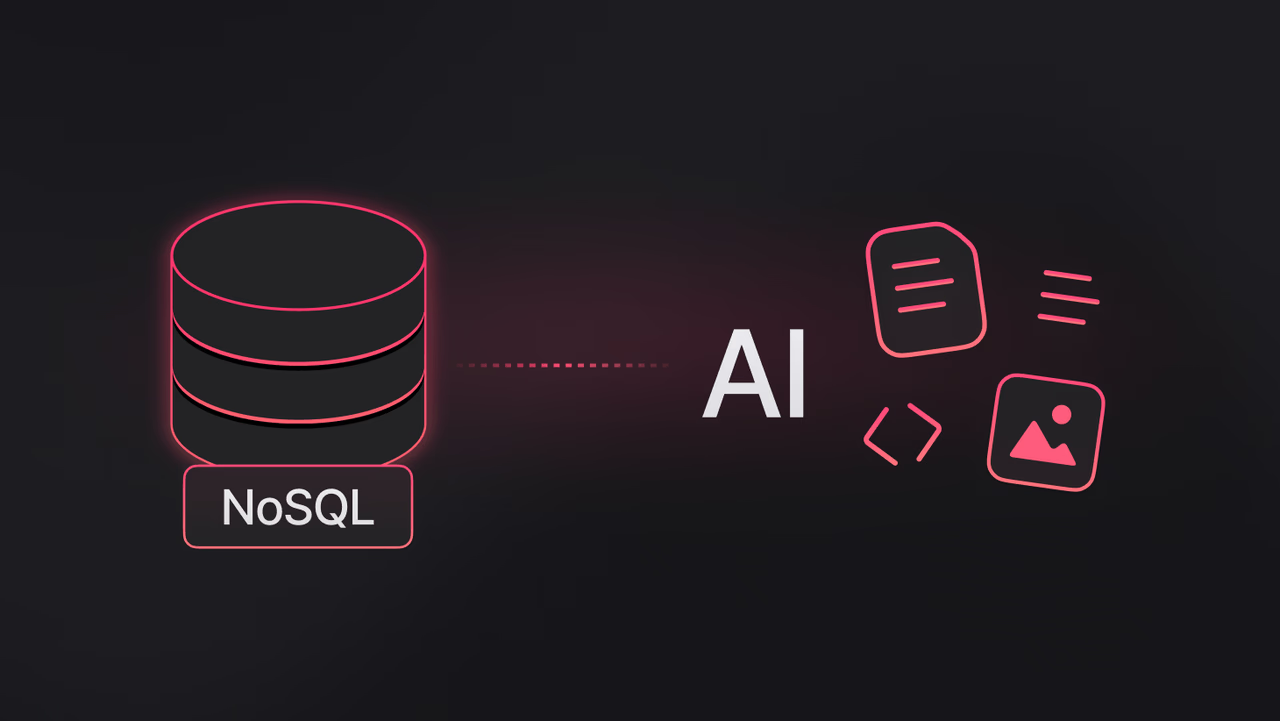
Most AI systems have a data problem that isn't about the model. It's about everything the model touches, the prompts going in, the outputs coming out, the embeddings powering retrieval, and the metadata tying it all together. None of this fits neatly into rows and columns. That's the core reason NoSQL for unstructured data is growingly becoming the standard in production AI systems.
This post breaks down exactly how NoSQL handles the three data types AI applications depend on most: text, images, and embeddings, and why relational databases struggle with each of them.
The unstructured data problem in AI
A typical AI interaction generates more data than it appears to. A single user query might produce a prompt, a model response, a confidence score, token usage metrics, tool call results, source citations, and a vector embedding, all from one request. That data is nested, variable in shape, and changes every time a new model feature gets added.
Relational databases handle this, but not gracefully. Each new field means a schema change. Each schema change means a migration. Each migration means coordination, downtime risk, and engineering time spent on infrastructure instead of the product. For AI teams iterating frequently, that overhead adds up fast.
NoSQL for unstructured data sidesteps this entirely. Documents can hold nested, variable structures without a predefined schema, meaning the data can be stored as-is, evolved freely, and queried without joins across multiple tables. The database adapts to the AI system rather than the other way around.
How NoSQL handles text data
Text is the most common data type in AI applications, and also one of the hardest to fit into a relational model. Prompts vary in length. Conversations grow over time. Summaries, extracted insights, and source references each carry their own metadata. None of this has a consistent shape.
NoSQL for unstructured data handles text through document storage, each record is a self-contained JSON-like object that can include the message content, associated metadata, timestamps, user context, and model outputs all in one place. There's no need to split a single AI interaction across multiple tables and reassemble it with joins at query time.
This matters most in conversational AI, where session history, context windows, and user preferences need to be stored and retrieved quickly as a unit. Document databases keep that context together, which makes retrieval faster and the data model easier to reason about as the product evolves.
How NoSQL handles image and file data
AI products increasingly work with multimodal inputs: screenshots, PDFs, scanned documents, and uploaded files. The files themselves typically live in object storage, but the database still needs to handle everything around them: metadata, processing status, AI-generated descriptions, extracted text, and references back to the original content.
This associated data is inherently variable. A scanned invoice has different metadata than a user-uploaded photo or a PDF report. Forcing these different shapes into a single relational schema either means creating many nullable columns or building complex multi-table structures that slow down queries.
NoSQL for unstructured data stores each file's metadata as a document, flexible enough to accommodate different shapes for different content types, without schema changes every time a new file type is introduced. As the AI system grows to support new input types, the data model grows with it naturally.
How NoSQL handles embeddings
Embeddings are at the core of modern AI retrieval, semantic search, similarity matching, and RAG pipelines all depend on them. A vector embedding is a numeric representation of a piece of content, and it's only useful when it stays connected to the content it represents and the metadata needed to filter it correctly.
That metadata typically includes the source document, ownership and access permissions, content type, version, and timestamps. Without it, embeddings become difficult to filter, maintain, and update as content changes.
NoSQL for unstructured data keeps embeddings and their associated metadata in the same document, so retrieval queries can filter on permissions, recency, or source type without joining across tables. This keeps vector search fast and the data model clean, particularly as the number of embeddings grows and filtering requirements become more complex.
Putting it together: NoSQL across the AI pipeline
AI is not a single step, it's a pipeline. Data gets ingested, stored, enriched, embedded, retrieved, and fed back into the model. Each stage generates data that needs to be stored alongside context from the stages before it.
NoSQL for unstructured data supports this end-to-end because the flexible document model works across all three data types consistently. Text, image metadata, and embeddings can live in the same collection, carry the same metadata structure, and be queried with the same patterns. Teams don't need different storage strategies for different data types, the model accommodates all of them.
The result is fewer migrations as the pipeline evolves, less fragmentation across tables, and a data layer that keeps pace with the product rather than slowing it down.
Building AI pipelines with Appwrite and MongoDB
Handling unstructured AI data well requires more than the right database. Production AI backends also need secure file storage for images and documents, authentication and access control for managing permissions on sensitive data, and real-time capabilities for pipelines that update continuously.
Appwrite brings all of this together in one open-source platform. Auth, APIs, storage, functions, and real-time events are all included out of the box, so teams can focus on the AI work rather than assembling backend infrastructure from scratch.
For teams already running MongoDB, Appwrite's self-hosted version now supports it natively. You can try it out by self-hosting Appwrite with MongoDB configured.
Closing thoughts
Text, images, and embeddings are the raw material of modern AI applications, and none of them fit neatly into a relational schema. NoSQL for unstructured data handles all three naturally, keeping related context together, adapting to structural changes without migrations, and scaling with the pipeline as AI workloads grow. For teams building AI products, getting the data layer right from the start is one of the highest-leverage decisions they can make.